Which countertop material is your first choice?
Engineered quartz led Houzz's 2026 study at 32% of upgraded counters.
No votes yet. Yours will be the first. · saved on this device
Loading...
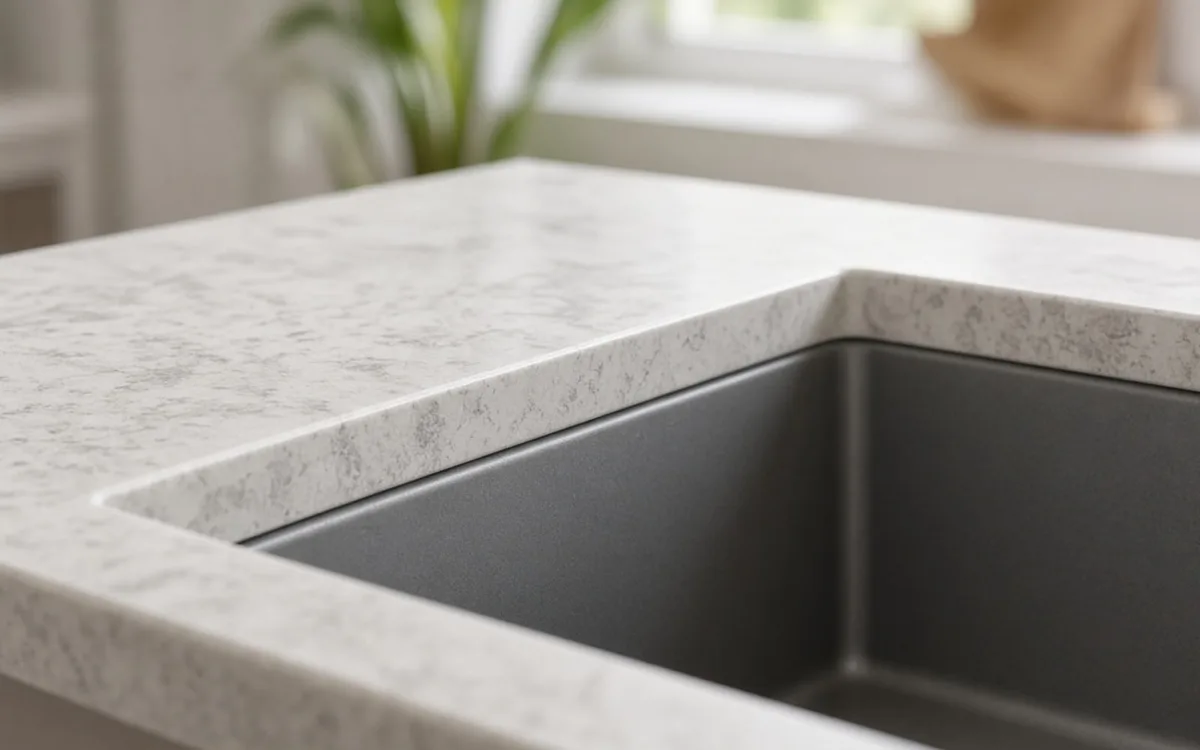
Kitchen Scopebook · Service guide
Countertop installation replaces the work surface, sink and often the backsplash on cabinets you keep. It suits kitchens where the surface is worn, stained or damaged, or where you want a different sink. Installed costs run roughly $40 to $150 per square foot depending on material, and the total depends as much on seams, edges and cutouts as on the slab.
Countertops are the most-replaced element in a kitchen: 91% of Houzz kitchen renovators upgraded them. They are also the item homeowners most often price wrong, because the per-square-foot number in a showroom covers material only. The installed price adds templating, fabrication, edge profile, sink and cooktop cutouts, seams, removal of the old top, and a plumber to reconnect the sink and disposal.
This page compares the materials by what they cost installed, how they behave under a cook who uses them hard, and what fails first. It then covers how the sink choice changes the job, where seams land, what climate does to each material, and what a proposal must list before you can compare two of them. If you are also replacing cabinets, read the cabinet page first; counters are templated only after boxes are set.
Want the numbers only? Read the countertop installation cost guide for 2026 ranges, what moves the price, and sample budgets.
| Item | Low | High | Unit | Notes |
|---|---|---|---|---|
| Laminate, installed | $25 | $50 | per sq ft | Post-formed or custom edge |
| Butcher block, installed | $40 | $100 | per sq ft | Maple, oak, walnut |
| Granite, installed | $50 | $120 | per sq ft | Level 1–3 slabs |
| Engineered quartz, installed | $60 | $130 | per sq ft | Includes templating and standard edge |
| Quartzite or marble, installed | $80 | $200 | per sq ft | Slab selection at the yard |
| Sink or cooktop cutout | $150 | $400 | per fixture | Undermount adds edge polishing |
| Old countertop removal and disposal | $200 | $600 | flat | Tile on mortar bed higher |
| Plumbing reconnection | $250 | $600 | flat | Sink, faucet, disposal, dishwasher |
Engineered quartz leads at 32% of Houzz upgrades, and 62% of NKBA's designers expect it to stay on top. It is non-porous, needs no sealing, and shrugs off wine and turmeric. Its weakness is heat: a hot pan left on it can scorch the resin, and it cannot be used outdoors. Granite is nearly as durable, tolerates heat, needs sealing every one to three years, and is what 73% of NAHB-surveyed buyers say they want.
Quartzite is a natural stone harder than granite with marble-like veining and a marble-like price; some slabs sold as quartzite are softer than advertised, so ask for a scratch test. Marble stains and etches from anything acidic and suits people who accept patina. Butcher block is the least expensive natural option, warms a kitchen visually, and needs oiling; it should not surround an undermount sink without careful sealing. Laminate is the budget floor and has improved in appearance, but seams and edges are visible and it cannot take an undermount sink well.
Some counters now serve a second zone. Houzz's 2026 Kitchen Trends Study found 14% of renovators added a breakfast bar and 9% a baking station, and among those who built a butler's or prep pantry, 61% included a prep counter. Each is extra square footage, often in a different material: a marble or butcher-block baking surface beside a quartz perimeter is common, and it should appear as its own line with its own edge and seam details.
| Material | Installed, per sq ft | Heat | Sealing | What fails first |
|---|---|---|---|---|
| Laminate | $25 – $50 | Poor | None | Edges and seams swell if wet |
| Butcher block | $40 – $100 | Fair | Oil 2–4×/yr | Water damage at sink |
| Engineered quartz | $60 – $130 | Fair | None | Scorch marks from hot pans |
| Granite | $50 – $120 | Good | 1–3 yrs | Chips at edges, stains if unsealed |
| Quartzite | $80 – $200 | Good | 1–2 yrs | Etching on softer slabs |
| Marble | $70 – $200 | Good | 6–12 mo | Etching and staining |
| Porcelain / sintered | $70 – $160 | Excellent | None | Chips at edges, hard to repair |
A typical kitchen has 50 to 65 square feet of counter. At quartz prices, the material and fabrication for that area runs $3,000 to $8,000, but the total on a proposal has more lines. Templating is often included; a laser or physical template is made after cabinets are set. Edge profile is priced per linear foot: an eased or small bevel is standard, while ogee or mitered waterfall edges add $10 to $40 per foot. Sink cutouts run $150 to $400 each, cooktop cutouts similar, and undermount sinks add polishing of the cutout edge.
Removal and disposal of the old top adds $200 to $600, more for tile on a mortar bed. Plumbing reconnection of the sink, faucet, disposal and dishwasher is $250 to $600 if nothing changes and more if the new sink is deeper and the drain must drop. Backsplash tile, if included, is its own line. Fixr's budget allocation gives countertops 40% of a full kitchen budget on the cabinetry side and 14% for counters, a useful sanity check on any proposal.
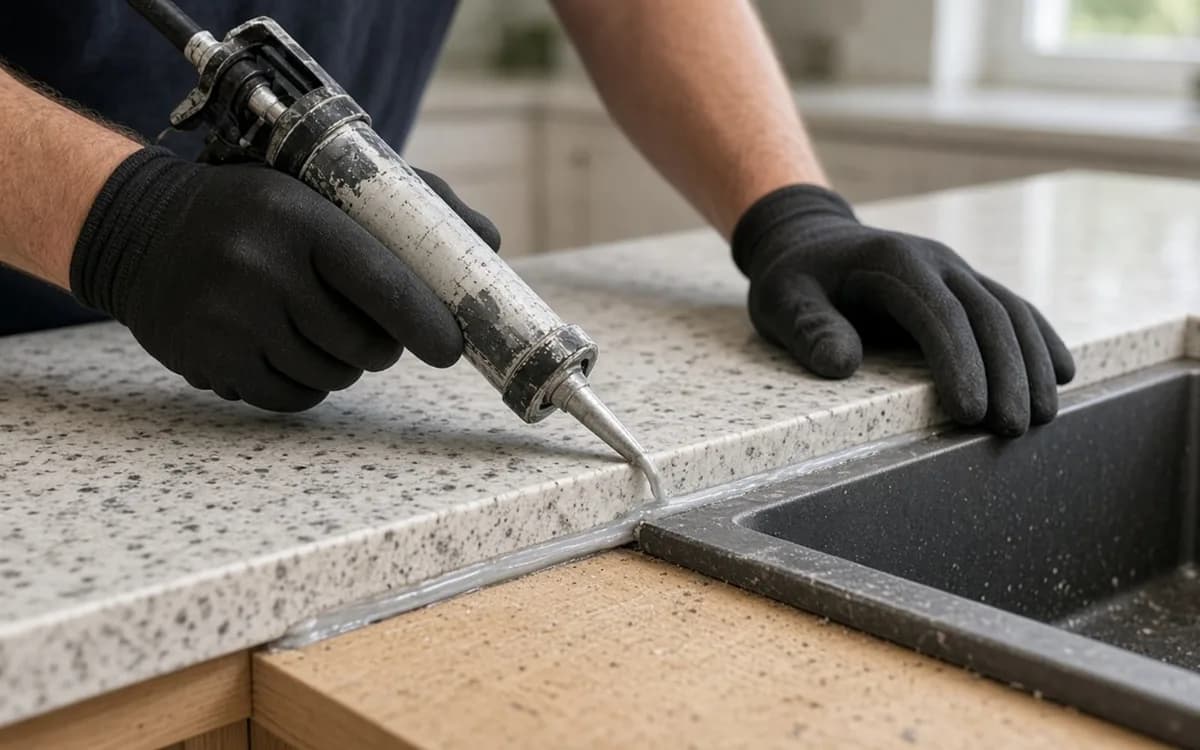
The sink decides the cutout, the support and the schedule. An undermount sink must be on site at templating so the fabricator can cut to its exact flange; it is mounted to the underside of the slab with clips or epoxy, and quartz and stone handle this well while laminate does not. A drop-in sink sits on the counter, hides an imperfect cutout, and can be changed later. A farmhouse or apron-front sink requires a modified sink base and often a new cabinet, so it belongs in a cabinet conversation, not just a counter one.
Bowl configuration follows how you wash. A single large bowl fits sheet pans; NAHB found 78% of buyers rate a double sink desirable. Depth matters: a 10-inch bowl on a standard 36-inch counter is hard on the back for shorter cooks. Faucet holes are drilled at fabrication, so pick the faucet before templating. Every one of these choices is a line on the proposal, and every one is cheaper to make before the slab is cut.
Quartz slabs are typically about 120 by 55 inches (jumbo slabs to 130 by 65), granite slabs vary. Any run longer than a slab, and most L-shaped kitchens, will have at least one seam. A good fabricator places seams away from the sink cutout and cooktop, keeps them out of the main prep zone, and matches pattern direction. Seams in quartz are filled with color-matched adhesive and should be under a sixteenth of an inch wide and flush to the touch. Ask for the seam locations on the drawing before you approve it.
Overhangs need support. Quartz can cantilever about 12 inches unsupported at three-centimeter thickness; beyond that, or on any island seating overhang, steel brackets or corbels are required. Dishwasher openings need a strip of plywood or a metal bracket under the slab so the dishwasher can be anchored. These items are cheap and often forgotten, and a slab that cracks over a dishwasher opening is expensive to replace. By our analysis of the EIA's 2024 survey, 20.6% of occupied homes run a dishwasher ten or more years old, so confirm any new unit's height before templating.
Visit one: the fabricator or installer measures, confirms the sink and faucet models, and prices. If cabinets are new, templating waits until they are set and level. Templating takes an hour or two; fabrication takes five to fourteen days depending on the shop and the material. Installation day: old top removed in the morning, new pieces set on silicone beads, seams filled and polished, sink clipped in. A plumber reconnects the same day or the next. The sink is typically out for one to three days on a straight replacement.
Fabrication is also where the one real health risk sits. The February 2026 OSHA and NIOSH hazard alert found engineered stone contains over 90% crystalline silica, against 10 to 50 percent for granite and under 5 percent for marble, and dust from dry cutting causes silicosis in fabricators. Ask for sink and cooktop cutouts to be made in the shop; any trimming in your kitchen should be wet-cut or done with a vacuum-shrouded tool. Ask the shop how it controls silica, and expect wet saws and respirators in the answer.
If the old counters are tile on a mortar bed, removal takes longer and may damage the cabinet tops, which then need a plywood underlayment before the slab. Ask whether a substrate is included. If the walls are out of square, the fabricator scribes the back edge to the wall or leaves a gap for backsplash tile to cover; ask which.
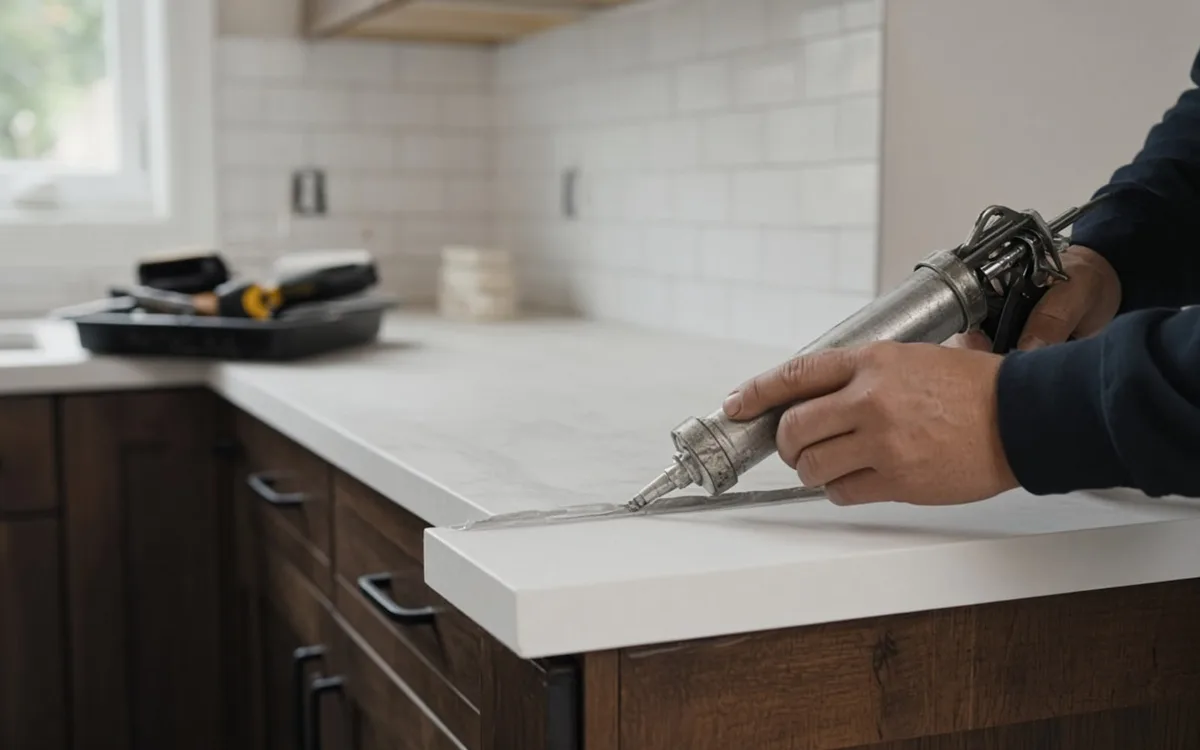
Unsupported overhangs and unbraced dishwasher openings lead the list, followed by seams placed across the sink, undermount sinks held by adhesive alone, and stone that was never sealed. Quartz scorched by a hot pan is nearly impossible to repair invisibly. Butcher block around an undermount sink blackens if the end grain is not sealed. Laminate installed over an old laminate top delaminates at the edges. None of these come from the material; they come from the details in the install.
Houzz found 37% of 2025 renovators went over budget, and material upgrades were the top reason. Countertops are where it happens: the showroom slab is $20 per square foot more than the sample you budgeted, and that is $1,300 on a 65-square-foot kitchen before edges. Decide the material and the slab before you sign, and write the slab lot number into the proposal. Buyer tastes still matter: NAHB found 73% of buyers rate granite or natural stone countertops essential or desirable.
Direct sun through a south or west window fades some quartz colors and yellows resins over years; natural stone and porcelain do not fade. In the humid South, butcher block moves more with seasons and needs a stronger oil schedule. In the dry West, wood tops can check at the ends. Cold-climate homes with radiant floor heat should keep stone from direct contact with the heat source to avoid stress cracking at seams.
Regional slab availability shapes price more than most homeowners expect: granite is cheaper near ports and distribution hubs in the Southeast, while quartzite and marble are priced higher in the Midwest because they are trucked farther. Ask the fabricator which colors are stocked locally, because a stocked slab avoids a freight charge and a three-week wait. The locations hub carries regional notes for the rest of the kitchen.
Require the square footage, material by brand and color, thickness (two centimeters with a built-up edge versus three centimeters), edge profile, number and type of cutouts, seam count, sink type and whether the sink is supplied, removal, plumbing reconnection, and backsplash scope. A proposal at $4,200 that excludes plumbing and removal is not cheaper than one at $4,800 that includes both.
Run the calculator with your counter area to check the material line, then use the quartz-versus-granite comparison to settle the material. When you are ready, send the same brief, including sink and faucet models, to several independent fabricators through the request form so the written proposals line up. Ask each fabricator to confirm the slab lot before templating.
Homeowner polls
Engineered quartz led Houzz's 2026 study at 32% of upgraded counters.
No votes yet. Yours will be the first. · saved on this device
No votes yet. Yours will be the first. · saved on this device
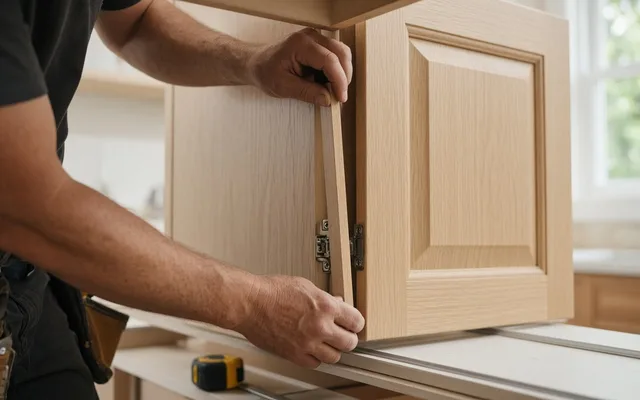 Service guideCabinet Refacing & Installation
Cabinet refacing replaces doors, drawer fronts and hardware and covers the exposed box faces with matching veneer, leaving the layout unchanged.
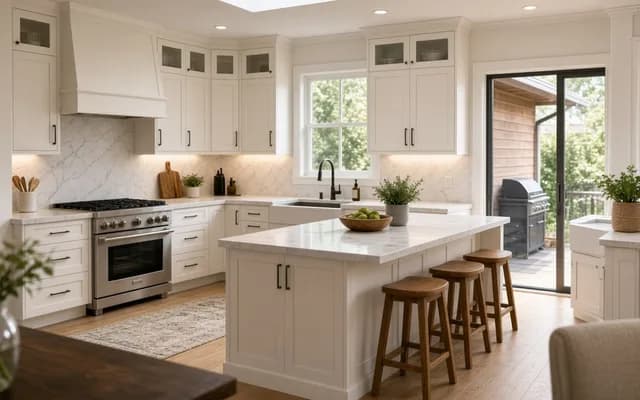 Service guideComplete Kitchen Renovation
A complete kitchen renovation replaces cabinets, counters, flooring, lighting and usually appliances under a single plan, and may relocate plumbing, gas and electrical or remove a wall.
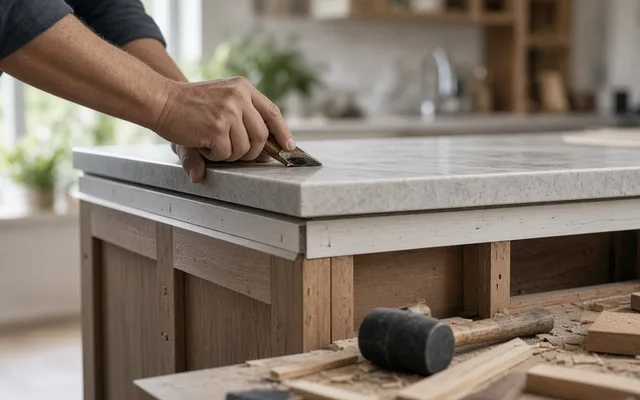 Service guideKitchen Island Design & Build
A kitchen island is a freestanding cabinet unit with its own countertop, often with seating, storage, a sink or a cooktop.
Both hold up. Quartz needs no sealing and resists stains, which suits a busy kitchen; granite tolerates a hot pan set down without a trivet, which quartz does not. If nobody in the house will remember to reseal, choose quartz. If pans come straight from the oven to the counter, choose granite or porcelain.
Yes, provided the cabinets are level and sound. The installer will check with a straightedge and shim high spots or add a plywood substrate where needed. If the boxes are more than a quarter-inch out of level over a run, the slab can crack at seams, so fixing that comes first. Sink bases with water damage should be repaired before a heavy stone top goes on.
Three centimeters (about 1.25 inches) is the standard for kitchens and needs no plywood underlayment. Two centimeters is lighter and cheaper but usually needs a substrate and a laminated edge to look thick. For islands with seating overhangs, three centimeters with proper brackets is the safer choice.
It helps. The fabricator will ask where you want seams, which edge profile, how far the overhang extends, and where the faucet holes go. Having the sink and faucet physically on site is required for undermount installs. Decisions made at templating are cut into stone a week later, so this is the last practical point to change your mind.
Level-one granite from a local yard is often cheaper than mid-range quartz and is real stone. Prefabricated granite or quartz pieces with finished edges, sold in fixed lengths, can cut fabrication costs for simple straight runs. Laminate with a stone print is the lowest cost but does not accept an undermount sink and shows seams.
Most granites need a penetrating sealer every one to three years; denser, darker slabs can go longer. Test by putting a few drops of water on the surface: if it darkens within a few minutes, reseal. Sealing takes an hour with a wipe-on product. Quartz and porcelain never need it.
Sometimes. If the new top is the same thickness and the old one comes out cleanly, the tile can stay, with a bead of caulk at the joint. A thicker slab or a different edge will leave a gap or an overlap. Many homeowners replace the backsplash at the same time because the tile above the old top rarely survives removal intact.
Because they are not the same scope. One may include removal, plumbing, sink and a premium edge; another may exclude all four. Slab grade within a brand also varies: a level-one color and a level-five color from the same manufacturer can differ by $30 per square foot. Compare line items and the exact color name, not totals.
 Free toolKitchen remodel cost calculator
Size, material tier and complexity in, a realistic budget range out.
 Free toolKitchen comparisons: the five decisions that move the budget
Side-by-side tables for the decisions that change the price most.
 Free toolKitchen remodel quiz: find your scope and check the numbers
10 questions that show what you already know and what to check next.
 Free toolKitchen remodel polls: see what other homeowners are choosing
See what other planners chose and add your vote.
Tell us the size, the condition of what is there now, and what you want to change. Kitchen Scopebook passes your request to independent local professionals, who reply with written, no-obligation estimates. The service is free to use.