Northeast
Highest gas-range share (40.4%) and lowest dishwasher share (67.5%) in EIA's 2024 stock data. Older housing means electrical, plaster and plumbing surprises; hold a 15% reserve and expect labor above the national average.
Loading...
Kitchen Scopebook · Locations
National averages hide a wide regional spread. Labor rates, housing age, what fuel the range uses, permit rules and climate all shift the scope and the price of a kitchen remodel. This hub summarizes the planning differences across the Northeast, South, Midwest and West so you can adjust the national benchmarks before requesting estimates from independent local pros.
Angi's national average of $26,940 is built from 13,100 projects across every market. A same-scope kitchen in Boston and in Birmingham will not land on the same number, because labor is the largest variable cost and it differs by half or more between metros. Housing age matters as much: a 1920s Northeast kitchen with knob-and-tube wiring carries electrical scope that a 2005 Sun Belt kitchen does not.
Use them to reset expectations before you run the calculator and before you send a brief through the contact page to pros who work in your area.
Highest gas-range share (40.4%) and lowest dishwasher share (67.5%) in EIA's 2024 stock data. Older housing means electrical, plaster and plumbing surprises; hold a 15% reserve and expect labor above the national average.
Electric ranges dominate (63.1%), so induction swaps rarely need new circuits. Slab foundations make sink and island plumbing relocation expensive; humidity argues for MDF-panel painted doors and a stricter oil schedule on wood tops.
Basements under most kitchens simplify moving plumbing and running new circuits. Labor runs below the national average; stone freight runs above it. Painted solid-wood doors show winter joint cracks, so specify MDF centers.
Seismic codes require anchoring tall cabinets and islands; some cities restrict new gas lines, pushing projects to induction. Strong sun fades some quartz and laminate colors, and coastal metros carry the highest labor rates.
Labor is about 25% of a kitchen budget by HomeAdvisor's breakdown, and skilled-trade rates in the Northeast and West Coast metros run well above the Midwest and South. Permit fees and inspection requirements vary by city; some require a licensed plumber and electrician for any work, while others allow a general contractor's crew to do rough-in. Material freight is a second factor: stone and cabinets trucked far from ports and factories cost more in the interior West and upper Midwest.
Housing stock sets hidden-condition risk. Older regions carry more galvanized plumbing, undersized panels and plaster walls, each of which adds labor. Newer Sun Belt subdivisions are more likely to have slab foundations, which make moving a sink expensive but keep electrical simple. Ask local pros what they routinely find behind kitchen walls in your neighborhood's era of construction.
EIA's 2024 Residential Energy Consumption Survey shows 40.4% of occupied Northeast homes cook on a natural-gas range, against 16.0% in the South, where electric dominates. Our analysis of the same survey puts electric ranges at 51.7% of homes nationally and induction at just 5.2%, highest in the South at 6.2%, even as two-thirds of NKBA's designers expect it to lead within three years. Those shares use all occupied homes as the base; the state-by-state table on this page and on the research page counts gas against homes with a range (31.7% nationally) and induction against homes with an electric range (8%). The practical effect: a Southern kitchen switching to induction usually already has a 240-volt circuit behind the range, while a Northeast kitchen needs an electrician to add one, and possibly a panel upgrade.
Dishwasher ownership tells a similar story. The Northeast has the lowest share at 67.5%, reflecting older, smaller kitchens where adding one means a new circuit, a supply line and a cabinet cut. These are installed-stock figures, not purchase rates, but they explain why Northeast proposals carry more utility lines. Ask for that work as a separate line.
| Region | Gas range (2024 stock) | Electric range | Dishwasher | Planning note |
|---|---|---|---|---|
| Northeast | 40.4% | 39.6% | 67.5% | Expect electrical upgrades; older plaster and plumbing |
| Midwest | 31.1% | 52.8% | 71.7% | Basements simplify plumbing relocation |
| South | 16.0% | 63.1% | 78.6% | Slab foundations make sink moves costly |
| West | 35.2% | 40.4% | 77.9% | Seismic anchoring; electrification codes in some cities |
Appliance age varies less by region than fuel does, but it still shows up in proposals. Our analysis of the EIA's 2024 household survey found 20.6% of occupied homes running a dishwasher at least ten years old, from 19.2% in the Northeast to 22.6% in the West, and 26.6% running a main refrigerator that old, highest in the Midwest at 28.4% and lowest in the South at 24.7%. Among owner-occupied dishwasher homes, those built before 1990 run an old machine 4.1 points more often than newer houses, a modest gap that argues for testing the machine rather than judging by the house's age.
Layout habits differ more. The same analysis found 16.4% of homes using a wall oven: 20.6% in the West and 18.8% in the South against 11.6% in the Northeast and 11.5% in the Midwest. Wine chillers follow a similar line at 5.4% nationally, 7.0% in the West and 3.8% in the Midwest. Where a wall oven is already in place, a cooktop island can keep it; where it is not, price the tall cabinet and second circuit as new work.
Humidity drives wood movement. Painted solid-wood doors show joint cracks through Northeast and Midwest winters; MDF center panels avoid it. Butcher block needs a heavier oil schedule in the Gulf states. Thermofoil can delaminate near ovens in hot kitchens without air conditioning. Direct sun in the Southwest fades some quartz resins and dark laminates, while natural stone and porcelain do not fade.
Ventilation rules differ too. Tight, cold-climate houses are the ones where a hood above 400 CFM most often requires make-up air, because the house has no leaks to supply it. Coastal regions add corrosion concerns for hardware and appliance finishes. The countertop page and cabinet page carry material-specific notes. Ask the HVAC line to state the hood CFM.
Start from the scope range on the services hub, then shift it by the labor factor pros in your area quote. As a rough planning rule, coastal Northeast and West Coast metros run 15 to 35 percent above the national figures for the same scope, the interior South and Midwest 10 to 20 percent below, and mountain and rural markets vary with freight and trade availability. Older housing adds a hidden-condition reserve of 15 percent rather than 10.
Resale expectations move with the market too. Zonda's Cost vs. Value data is published by region and metro, and the minor remodel's 112.9% national recoup figure is higher in some Western markets and lower in the Midwest. Check the regional table before letting resale drive the scope. Local pros will know which finishes buyers in your area expect.
Homes cooking on a natural-gas range: 31.7% nationally. Highest in New Jersey (64.4%), California (60.6%), Illinois (59%); lowest in Florida (5.1%), Hawaii (6.2%), North Carolina (8.5%).
Homes with an induction cooktop: 8% nationally. Highest in District of Columbia (14.1%), California (12.3%), Minnesota (11.5%); lowest in North Carolina (5.5%), Alabama (5.8%), Tennessee (6.1%).
Homes with a dishwasher: 75.1% nationally. Highest in Utah (91.5%), Colorado (88.5%), Nevada (86.3%); lowest in Hawaii (42.6%), New York (61.1%), West Virginia (62.1%).
Kitchen Scopebook calculated these state estimates from the Energy Information Administration's 2024 household survey microdata. EIA publishes the 2024 survey nationally and by region, not by state. Shares are weighted; a dash means the state sample was too small for a reliable estimate (fewer than 100 households, fewer than 10 yes answers, or a relative standard error above 30%). Source data.
| State | Homes cooking on a natural-gas range | Homes with an induction cooktop | Homes with a dishwasher |
|---|---|---|---|
| United States | 31.7% | 8% | 75.1% |
| Alabama | 14.4% | 5.8% | 76.3% |
| Alaska | 31.7% | — | 72.3% |
| Arizona | 30.8% | 8.9% | 83.6% |
| Arkansas | 19.2% | 10.3% | 72.3% |
| California | 60.6% | 12.3% | 72.3% |
| Colorado | 21.4% | 8% | 88.5% |
| Connecticut | 23% | 8.7% | 70.6% |
| Delaware | 23.5% | — | 80.7% |
| District of Columbia | 46.2% | 14.1% | 76% |
| Florida | 5.1% | 9.2% | 83.7% |
| Georgia | 25.4% | — | 81.2% |
| Hawaii | 6.2% | 10.9% | 42.6% |
| Idaho | 20.8% | — | 83% |
| Illinois | 59% | — | 72.2% |
| Indiana | 29.9% | — | 71.9% |
| Iowa | 25.6% | — | 71.4% |
| Kansas | 20% | — | 73.3% |
| Kentucky | 13.6% | — | 68.5% |
| Louisiana | 31.5% | — | 69.5% |
| Maine | — | — | 62.5% |
| Maryland | 35.9% | 11% | 84.1% |
| Massachusetts | 39.2% | 10.2% | 77.8% |
| Michigan | 35.3% | — | 72.7% |
| Minnesota | 32.6% | 11.5% | 82% |
| Mississippi | 17% | — | 70.3% |
| Missouri | 20.1% | 9.8% | 73.1% |
| Montana | 19.9% | — | 75.8% |
| Nebraska | 13.6% | — | 80% |
| Nevada | 52.2% | — | 86.3% |
| New Hampshire | 12.9% | — | 74.7% |
| New Jersey | 64.4% | — | 70.5% |
| New Mexico | 47.6% | — | 69.7% |
| New York | 53.4% | 10.8% | 61.1% |
| North Carolina | 8.5% | 5.5% | 78.3% |
| North Dakota | 11.9% | — | 85.2% |
| Ohio | 32.7% | 7.8% | 62.6% |
| Oklahoma | 33.1% | — | 76.9% |
| Oregon | 21.4% | — | 83.8% |
| Pennsylvania | 37.5% | 8.2% | 68.2% |
| Rhode Island | 35.4% | 9.3% | 67.1% |
| South Carolina | 11.6% | — | 80% |
| South Dakota | 16.1% | — | 82.6% |
| Tennessee | 13.5% | 6.1% | 77.8% |
| Texas | 26.6% | 8% | 78.1% |
| Utah | 29.9% | — | 91.5% |
| Vermont | 9.2% | — | 71.8% |
| Virginia | 23.1% | 7.7% | 81.3% |
| Washington | 14.7% | 10.8% | 84.9% |
| West Virginia | 21.6% | — | 62.1% |
| Wisconsin | 27.5% | — | 68.4% |
| Wyoming | 29.3% | — | 75.7% |
Homeowner polls
EIA's 2024 RECS shows induction in about 5% of occupied homes; NKBA designers expect it to lead within three years.
No votes yet. Yours will be the first. · saved on this device
Angi's national average is $26,940; Houzz's major-remodel median is $55,000.
No votes yet. Yours will be the first. · saved on this device
For the same scope and materials, usually yes, by roughly 20 to 40 percent, driven by labor rates and permit costs. The gap narrows on material-heavy scopes such as countertop replacement, where slab pricing is national. Slab-foundation houses in the South can reverse the gap if the sink or island plumbing has to move.
It depends on the state and city. Many jurisdictions require licensed trades for any work on supply lines, gas or circuits, and require them to pull their own permits. Others allow a general contractor to perform or supervise the work. Ask the pro who will pull each permit and confirm with the local building department.
Yes, but the electrical scope is larger. A 40- or 50-amp 240-volt circuit must be run from the panel, and older panels in the Northeast and Midwest may lack capacity, adding a $1,500 to $4,000 upgrade. In the South, most kitchens already have the circuit behind an electric range. Gas capping is a small additional line.
Because more of what is behind the walls has to be replaced to pass inspection: ungrounded wiring, galvanized supply lines, drains without proper venting, out-of-level floors and plaster that does not patch cleanly. None of these are visible in a site visit, so pros in older-housing regions carry larger contingencies and price hidden conditions by the unit.
They do. Some cities issue a kitchen permit in a day with one final inspection; others require separate plumbing, electrical and mechanical permits, plan review for structural changes, and multiple inspections. Fees range from under $200 to several thousand dollars. The pro should list permit responsibility and estimated fees as a line item.
Somewhat. Stock and semi-custom lines ship nationally on similar schedules, but delivery to rural or mountain areas adds a week or more and freight charges. Local custom shops vary widely. Regions with strong spring and fall remodeling seasons see longer lead times in those months, so order early if the calendar matters.
Mostly at the margins. Strong sun through a south or west window can fade some quartz colors over years; natural stone and porcelain do not fade. Humid regions are harder on butcher block. Cold climates with radiant heat should isolate stone from the heat source. Inside a conditioned kitchen, quartz and granite perform well everywhere.
 Service guideComplete Kitchen Renovation
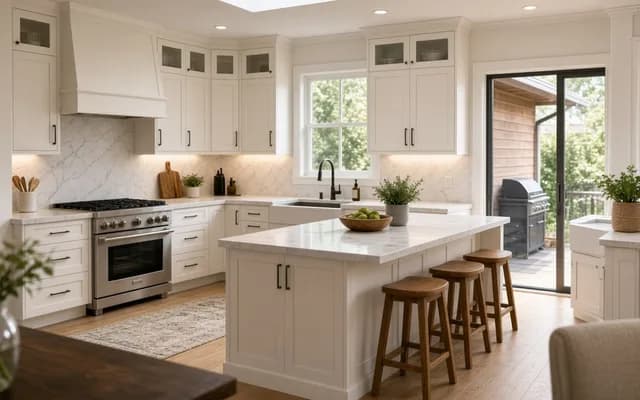
A complete kitchen renovation replaces cabinets, counters, flooring, lighting and usually appliances under a single plan, and may relocate plumbing, gas and electrical or remove a wall.
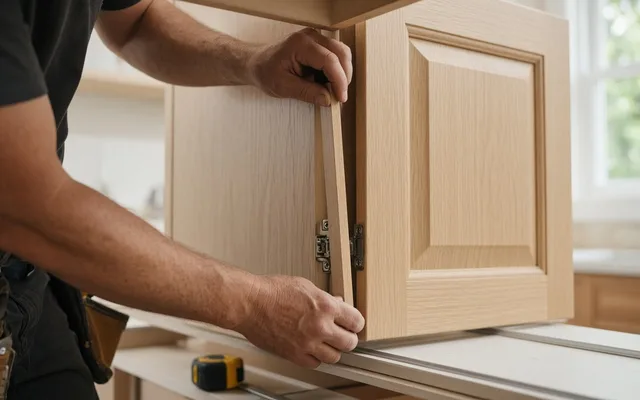 Service guideCabinet Refacing & Installation
Cabinet refacing replaces doors, drawer fronts and hardware and covers the exposed box faces with matching veneer, leaving the layout unchanged.
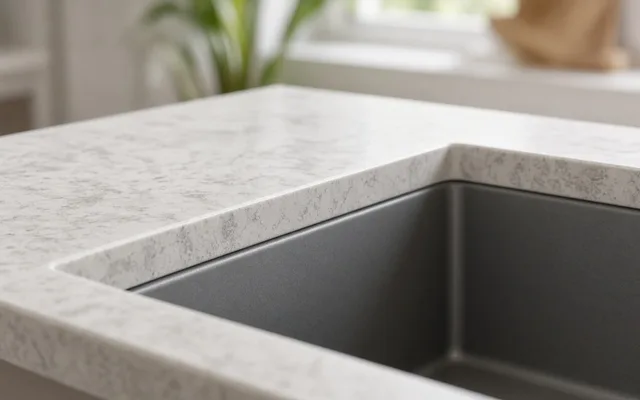 Service guideCountertop Installation
Countertop installation replaces the work surface, sink and often the backsplash on cabinets you keep.
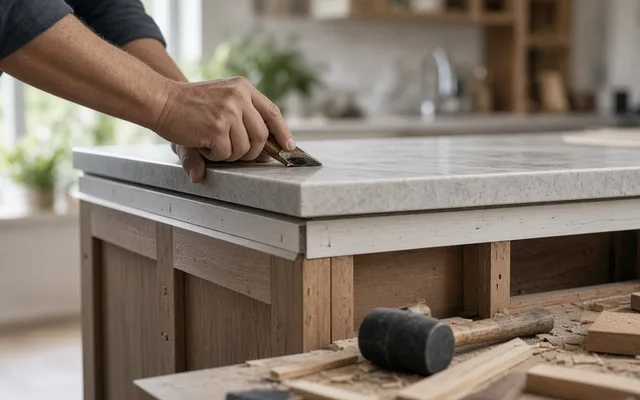 Service guideKitchen Island Design & Build
A kitchen island is a freestanding cabinet unit with its own countertop, often with seating, storage, a sink or a cooktop.
Tell us the size, the condition of what is there now, and what you want to change. Kitchen Scopebook passes your request to independent local professionals, who reply with written, no-obligation estimates. The service is free to use.